



You won!
How We Calculate Casino Similarity
Finding a new online casino that actually fits your play style shouldn't mean opening twenty tabs and comparing bonus terms by hand. On Casinos Analyzer, every casino page includes a "Similar Casinos" section — this page explains exactly how those matches are generated, so Canadian players can see the logic instead of taking it on faith.
Our engine compares each casino against every other casino in the database across up to 24 data points, from licensing to payment rails to bonus structure, and returns the closest matches ranked by a single similarity score.
What is a similarity score?
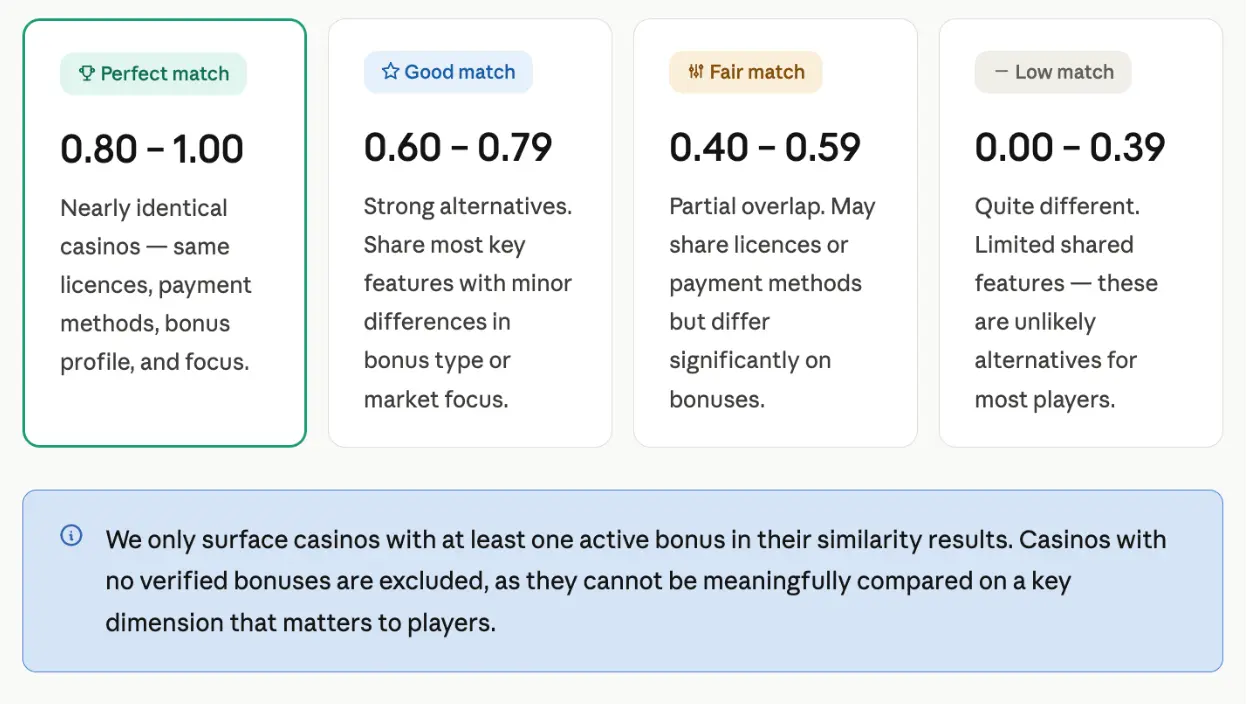
Every pairing gets a score between 0 and 1, split into four bands: Perfect match (0.80–1.00) — nearly identical casinos sharing licences, payment methods, bonus profile, and focus; Good match (0.60–0.79) — strong alternatives sharing most key features with minor differences in bonus type or market focus; Fair match (0.40–0.59) — partial overlap, may share licences or payment methods but differ significantly on bonuses; Low match (0.00–0.39) — quite different, unlikely to work as an alternative for most players. One thing worth knowing: we only surface casinos with at least one active bonus in similarity results — a casino with no verified bonus can't be meaningfully compared on a factor that matters this much to players.
What we compare — the 24 criteria
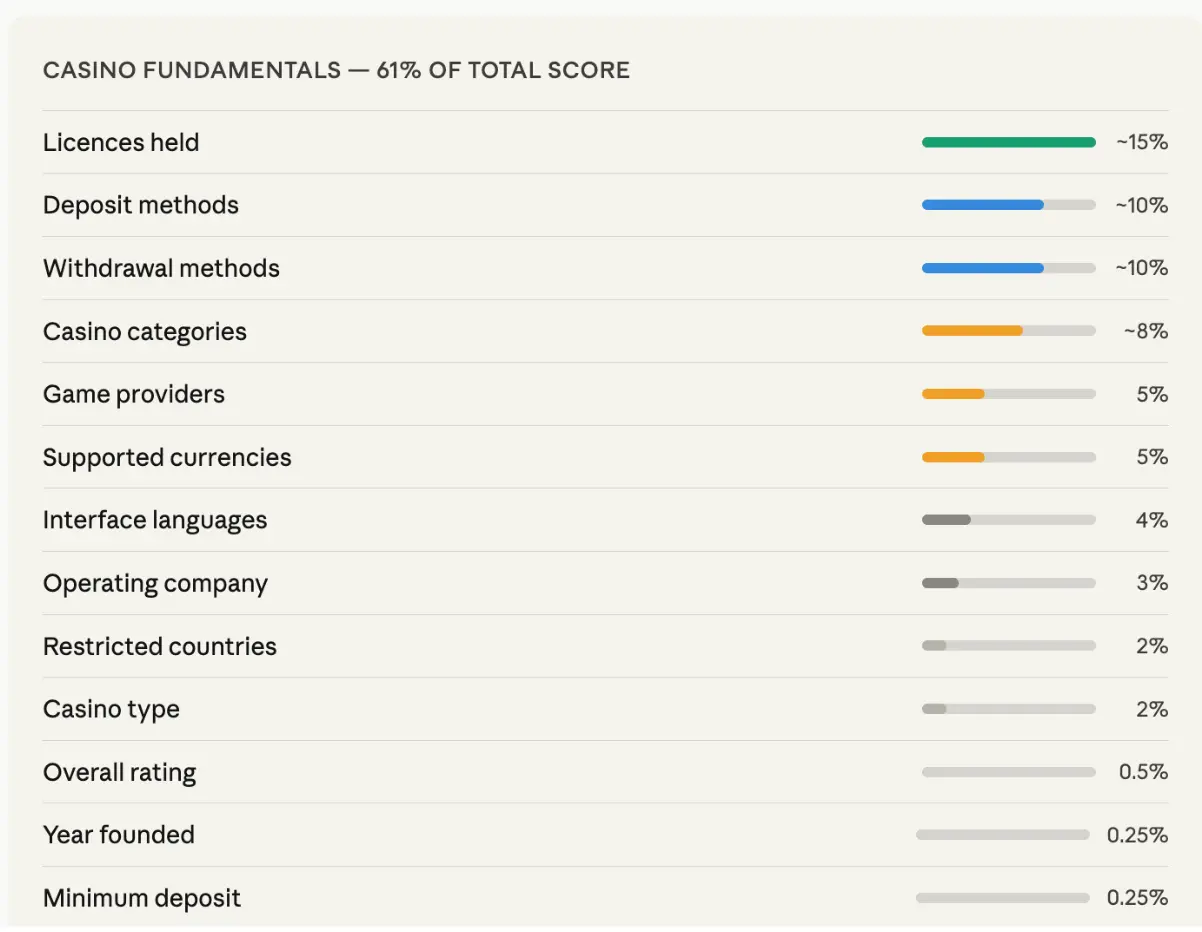
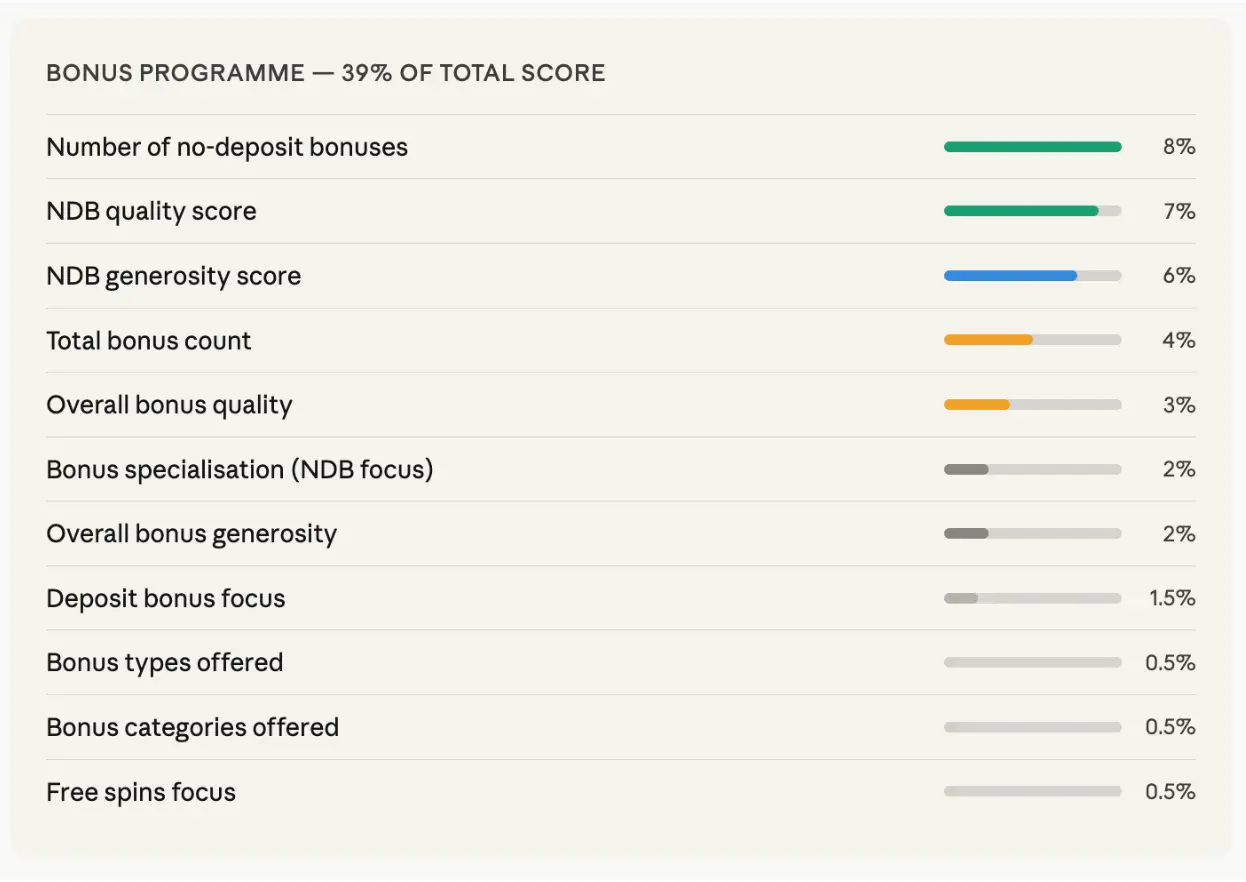
The 24 criteria split into two groups. Casino Fundamentals make up 61% of the total score: licences held (~15%), deposit methods (~10%), withdrawal methods (~10%), casino categories (~8%), game providers (5%), supported currencies (5%), interface languages (4%), operating company (3%), restricted countries (2%), casino type (2%), overall rating (0.5%), year founded (0.25%), and minimum deposit (0.25%). Bonus Programme makes up the remaining 39%: number of no-deposit bonuses (8%), NDB quality score (7%), NDB generosity score (6%), total bonus count (4%), overall bonus quality (3%), bonus specialisation/NDB focus (2%), overall bonus generosity (2%), deposit bonus focus (1.5%), and bonus types, categories, and free-spins focus (0.5% each).
For Canadian players specifically, that heavy licensing weight matters in practice — operators serving Canada typically hold a mix of Kahnawake Gaming Commission, Malta Gaming Authority, or Curaçao licences, and the exact mix says a lot about how you'd be treated if something went wrong.
If a casino is missing data for a criterion — say, no game provider information on file — that criterion's weight gets redistributed automatically across the rest, so the total always adds up to 100% and no casino is unfairly penalized for a data gap.

Bonus specialisation — what it is and why it matters
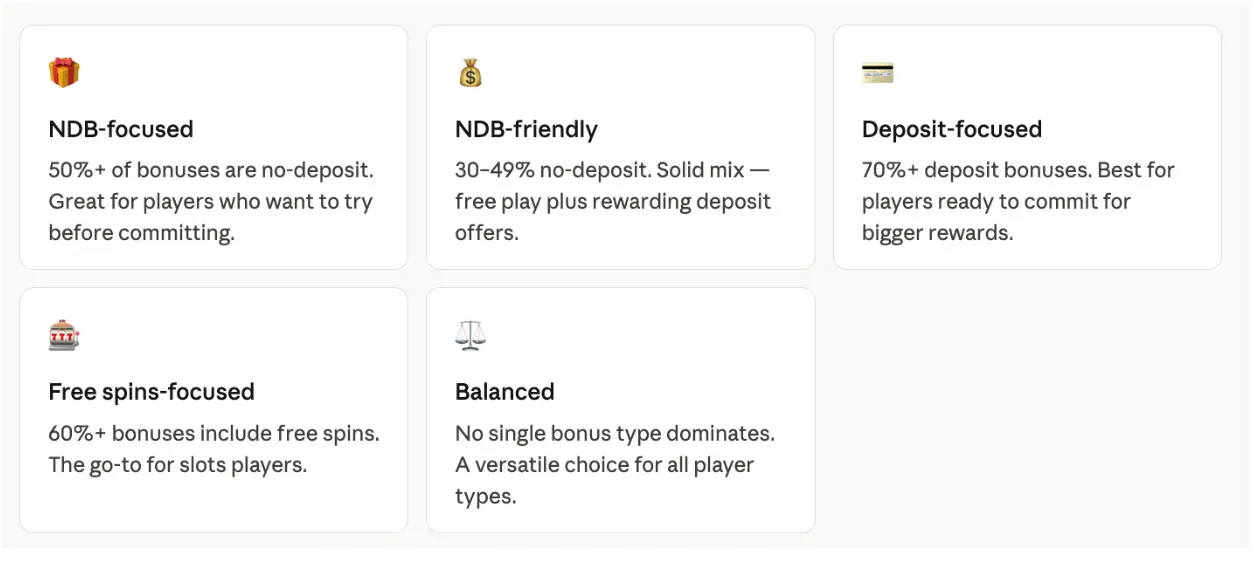
Two casinos can both list "30 bonuses" and feel completely different to play at. We classify each casino's bonus focus into one of five bands: NDB-focused (50%+ of bonuses are no-deposit — great for players who want to try before committing), NDB-friendly (30–49% no-deposit, a solid mix of free play and deposit offers), Deposit-focused (70%+ deposit bonuses, best for players ready to commit for bigger rewards), Free spins-focused (60%+ of bonuses include free spins, the go-to for slots players), or Balanced (no single bonus type dominates).
A balanced casino and an NDB-focused casino can post near-identical totals on paper while offering a very different day-to-day experience — which matters more to Canadian players hunting for a specific type of offer than the headline number ever does.
How the maths works
Two different formulas apply, depending on whether a criterion is a list or a number.
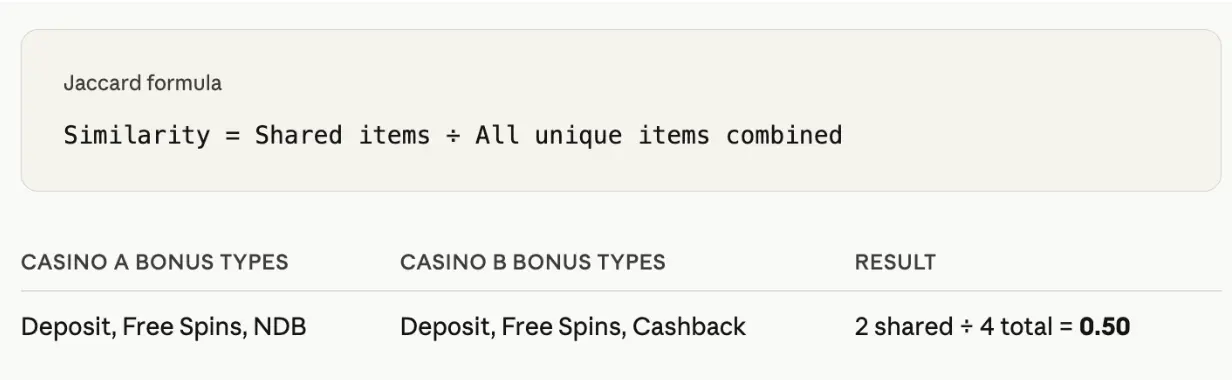
For lists: Jaccard similarity — Similarity = Shared items ÷ All unique items combined. Used for licences, payment methods, game providers, bonus types, and currencies (including whether a casino settles in CAD). Example: Casino A offers Deposit, Free Spins, and NDB bonuses; Casino B offers Deposit, Free Spins, and Cashback. That's 2 shared out of 4 unique items combined — a similarity of 0.50.
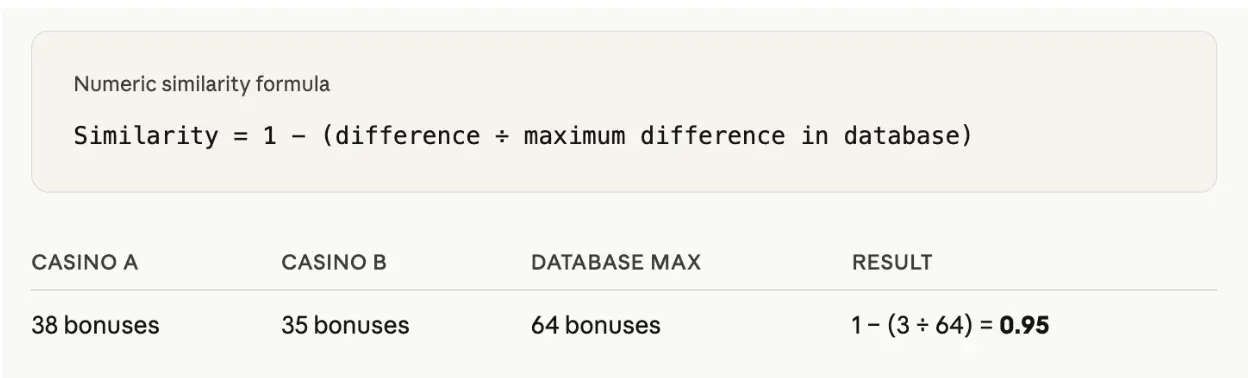
For numbers: proportional distance — Similarity = 1 − (difference ÷ maximum difference in database). Used for bonus counts, quality scores, and ratings. Example: Casino A has 38 bonuses, Casino B has 35, and the widest spread across the database is 64 bonuses. That's 1 − (3 ÷ 64) = 0.95.
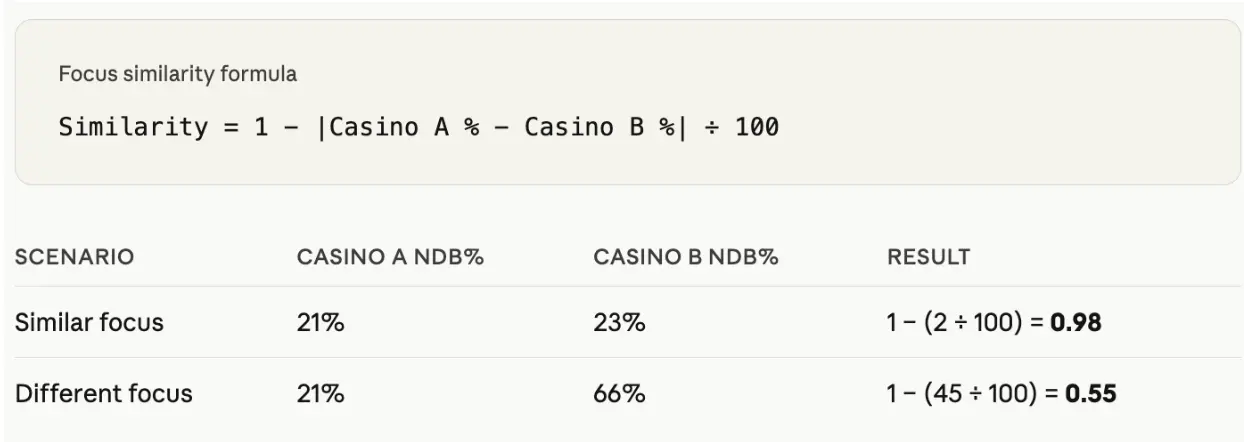
For bonus focus: percentage distance — Similarity = 1 − |Casino A % − Casino B %| ÷ 100. Used for NDB percentage, deposit-bonus percentage, and free-spins percentage. Example: two casinos at 21% and 23% NDB score 0.98 (very similar focus); two casinos at 21% and 66% NDB score only 0.55 (genuinely different focus).
A real-world example
Take a balanced reference casino with 38 active bonuses, 8 of which are no-deposit (a 21% NDB rate). Here's how three alternatives stack up:
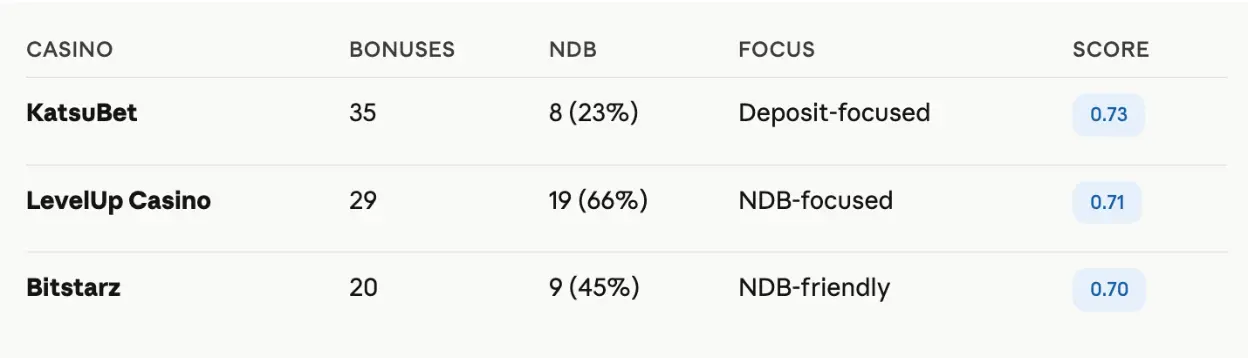
- KatsuBet — 35 bonuses, 8 no-deposit (23%), Deposit-focused → 0.73
- LevelUp Casino — 29 bonuses, 19 no-deposit (66%), NDB-focused → 0.71
- Bitstarz — 20 bonuses, 9 no-deposit (45%), NDB-friendly → 0.70
KatsuBet ranks highest because its bonus count and NDB volume sit closest to the reference casino, even with a slightly different overall focus. LevelUp Casino has far more no-deposit bonuses in absolute terms, but 66% of its whole programme is NDB-driven — a fundamentally different type of casino to play at — which is what pulls its score down despite the larger raw NDB count. Similarity scores like these update automatically as casinos add or remove bonuses, change payment methods, or acquire new licences, so what you see always reflects current data.

Why licences carry the most weight
Licensing accounts for roughly 15% of the total score, more than any other single factor. Two casinos regulated by comparable authorities are far more likely to share similar dispute-resolution processes, withdrawal timelines, and player protections than two casinos that simply happen to offer the same slot providers. For Canadian players choosing between a Kahnawake-licensed operator and one under an offshore licence, that distinction is often the difference that matters most.
Payment methods follow at roughly 10% each for deposits and withdrawals — Interac availability, e-transfer support, and CAD-friendly processing are exactly what makes an "alternative" casino feel like a real alternative rather than a downgrade.
Frequently asked questions
If you have any specific questions, please message us.
-
Why doesn't the casino with the most no-deposit bonuses always come out on top?
-
Because we're matching specialisation, not raw volume. LevelUp Casino has 19 no-deposit bonuses versus KatsuBet's 8, yet KatsuBet scores higher overall because its total programme shape is closer to the reference casino.
-
Can I filter results by bonus type?
-
Yes — every casino page lets you filter "Similar Casinos" by NDB-focused, NDB-friendly, deposit-focused, free-spins-focused, or balanced alternatives.
-
What happens if a casino is missing data?
-
The system redistributes that criterion's weight across the remaining factors automatically. No casino is penalized for a data gap — the match may just be slightly less precise until more information comes in.
-
How often do scores update?
-
Whenever new data lands for either casino in a pair — typically within 24 hours of a new bonus, a verified licence change, or a payment method update.